DRW-style probability and math-puzzle questions from a quant-leaning prop trading process — with full solutions.
Free preview
Full worked solutions
Easy
DRW is a quant-leaning principal trading firm, and its OA centres on probability and math-puzzle questions. The examples below sit at that difficulty. The later rounds — HR, technical interviews, and a final superday — run deeper and vary with the role and desk.
Sample Questions & Solutions
Each question is a real interview problem. Try it yourself first, the full solution is revealed below.
Q1
American vs. European Options
Easy
What is the main difference between an American and a European option?
Show solution
Options are financial derivatives that give the holder the right, but not the obligation, to buy or sell an underlying asset at a predetermined price, known as the strike price, within a specified period. There are two primary types of options: American options and European options. The main difference between these two types of options lies in the timing of when they can be exercised.
American Options An American option can be exercised at any time up until the expiration date. This flexibility allows the holder to capitalize on favorable market movements at any point during the option's life. For example, if the price of the underlying asset moves significantly in favor of the option holder before the expiration date, the holder can exercise the option to capture the profit immediately.
The ability to exercise at any time provides a strategic advantage, particularly in volatile markets or when the underlying asset pays dividends. For instance, an investor holding an American call option on a dividend-paying stock might choose to exercise the option just before the ex-dividend date to receive the dividend payment.
European Options In contrast, a European option can only be exercised at the expiration date, not before. This restriction means that the holder must wait until the expiration date to exercise the option, regardless of any favorable movements in the price of the underlying asset during the option's life. As a result, European options typically trade at a discount compared to American options, all else being equal, because they offer less flexibility to the option holder.
European options are often used in markets where the underlying asset is less volatile and the need for early exercise is minimal. The pricing of European options is generally simpler due to the fixed exercise date, making them a popular choice for certain financial models and strategies.
The pricing of American and European options also differs due to the exercise flexibility. The Black-Scholes model, for instance, is primarily used for pricing European options and assumes constant volatility and a constant interest rate. American options, however, require more complex models, such as the binomial options pricing model, which can accommodate the possibility of early exercise.
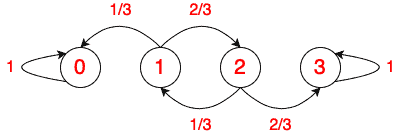
Two players, A and B, play a game in which the winner receives 1 dollar from the other player. Player A has 1 dollar and player B has 2 dollars. Player A is better in this game and wins 2/3 of the games. They play until one of them is bankrupt.
What is the probability that player A wins?
Show solution
This is a pretty straightforward Markov chain problem. There are 4 states. The transition graph is given in Figure 1.
Figure 1 - Transition graph for this problem.
The problem starts at state 1. As has been explained in the lessons of this course, we use the following equation:
\begin{equation}
s_1 = \sum_{i=0}^{3}p_{1,i}s_i
\end{equation} \begin{equation}
s_2 = \sum_{i=0}^{3}p_{2,i}s_i
\end{equation} Furthermore, $s_0=0$ and $s_3=1$. Then we have
\begin{equation}
s_1 = \frac{1}{3}*0 + \frac{2}{3} * s_2
\end{equation} \begin{equation}
s_2 = \frac{1}{3}* s_1 + \frac{2}{3} * 1
\end{equation} Solving these equations gives us $s_1=4/7$ and $s_2=6/7$. So, starting with 1 dollar, player A has a 4/7 chance of winning.
Proof If we substitute Equation 4 in Equation 3, we have
What’s the expected number of throws to see all of the faces of a die?
Show solution
This is called the coupon collector problem. For a fair n-sided die, the expected number of attempts needed to get all n values is \begin{equation}
n \Sigma_{k=1}^n \frac{1}{k}
\end{equation} which, for large n is approximately n log n.
The time until the first result appears is 1. After that, the random time until a second (different) result appears is geometrically distributed with parameter of success 5/6, hence with mean 6/5 (recall that the mean of a geometrically distributed random variable is the inverse of its parameter). After that, the random time until a third (different) result appears is geometrically distributed with parameter of success 4/6, hence with mean 6/4. And so on, until the random time of appearance of the last and sixth result, which is geometrically distributed with parameter of success 1/6, hence with mean 6/1. This shows that the mean total time to get all six results is \begin{equation}
6 \Sigma_{k=1}^6 \frac{1}{k} = \frac{147}{10} = 14.7
\end{equation}
What are the advantages of investing in ETFs compared to individual stocks?
Show solution
Exchange-Traded Funds (ETFs) are investment funds that are traded on stock exchanges, much like individual stocks. They hold assets such as stocks, commodities, or bonds and generally operate with an arbitrage mechanism designed to keep trading close to its net asset value, although deviations can occasionally occur. ETFs offer a blend of the characteristics of both mutual funds and individual stocks, providing investors with unique benefits that individual stock investments might not offer.
Diversification One of the most significant advantages of investing in ETFs is diversification. An ETF typically holds a broad range of securities, often encompassing an entire market index, a specific sector, or even a global market. This diversification reduces the risk associated with investing in a single company. If one company within the ETF performs poorly, it can be offset by the performance of other companies within the same fund. This risk mitigation is particularly appealing to investors seeking to reduce volatility and avoid the pitfalls of poor performance from individual stocks.
Cost Efficiency ETFs are known for their cost efficiency. They generally have lower expense ratios compared to mutual funds because they are passively managed, tracking an index rather than relying on active management. Additionally, ETFs incur lower transaction costs because they trade on exchanges like individual stocks, and investors can buy or sell them throughout the trading day. This flexibility allows investors to capitalize on market movements and manage their portfolios more actively and cost-effectively.
Liquidity and Flexibility ETFs offer superior liquidity compared to some mutual funds and individual stocks, especially those that are thinly traded. Since ETFs are traded on major stock exchanges, they can be bought and sold at market prices at any time during trading hours. This liquidity provides investors with the flexibility to enter or exit positions quickly and efficiently, which is particularly beneficial in volatile markets or when rapid investment decisions are necessary.
Transparency ETFs are highly transparent investment vehicles. The holdings of most ETFs are disclosed daily, allowing investors to see exactly what assets are in the fund at any given time. This transparency is a significant advantage over mutual funds, which typically disclose their holdings quarterly. Knowing the exact composition of the ETF helps investors make informed decisions and align their investments with their financial goals and risk tolerance.
Tax Efficiency ETFs are generally more tax-efficient than mutual funds. Due to their unique structure and the way they are traded, ETFs typically experience fewer taxable events. Mutual funds often distribute capital gains to investors, which can result in tax liabilities. In contrast, the in-kind creation and redemption process of ETFs minimizes the capital gains distributions, thus reducing the tax burden on investors. This tax efficiency makes ETFs an attractive option for taxable accounts.
You roll 3 dice and you multiply all face values. What is the probability that the outcome is even?
Show solution
For the outcome to be even is the same as the outcome not being odd. For the outcome to be odd, all three dice need to be odd, respectively:
1*1*1 = 1 (odd)
3*3*3 = 27 (odd)
5*5*5 = 125 (odd)
and also all combinations of the odd numbers result in odd outcomes, like:
1*1*3 = 3 (odd)
3*3*5 = 45 (odd)
etc.
Basically, multiplying odd numbers with each other results in an odd outcome. If ANY even number comes in play, then we have "a number" multiplying "an even number", which will always result in an even number. So, "odd * even * odd" will also result in even.
So, in any other scenario than multiplying three odd numbers, the product will be even. Therefore, the probability that the product is even is, given that half of the sides of the dice are odd ({1,3,5} vs {2,4,6}) equal to \begin{equation} P(even \; product) = 1 - P(only \; odd \; product) \end{equation} \begin{equation} P(even \; product) = 1 - (\frac{1}{2})^3 = \frac{7}{8} \end{equation}
You just worked through 5 of our free sample questions.
Full access unlocks 500+ interview questions, timed mock OAs, progress tracking, and detailed analytics
across every trading firm listed above.
Fill in your email if you want us to contact you for more information or follow up
Thank you for your feedback!
Manage your privacy
We use technologies like cookies to store and/or access device information. We do this to improve browsing experience and to show (non-) personalized ads. Consenting to these technologies will allow us to process data such as browsing behavior or unique IDs on this site. Not consenting or withdrawing consent, may adversely affect certain features and functions.
Functional
Always active
The technical storage or access is strictly necessary for the legitimate purpose of enabling the use of a specific service explicitly requested by the subscriber or user, or for the sole purpose of carrying out the transmission of a communication over an electronic communications network.
Preferences
The technical storage or access is necessary for the legitimate purpose of storing preferences that are not requested by the subscriber or user.
Statistics
The technical storage or access that is used exclusively for statistical purposes.The technical storage or access that is used exclusively for anonymous statistical purposes. Without a subpoena, voluntary compliance on the part of your Internet Service Provider, or additional records from a third party, information stored or retrieved for this purpose alone cannot usually be used to identify you.
Marketing
The technical storage or access is required to create user profiles to send advertising, or to track the user on a website or across several websites for similar marketing purposes.
To provide the best experiences, we use technologies like cookies to store and/or access device information. Consenting to these technologies will allow us to process data such as browsing behavior or unique IDs on this site. Not consenting or withdrawing consent, may adversely affect certain features and functions.
Functional
Always active
The technical storage or access is strictly necessary for the legitimate purpose of enabling the use of a specific service explicitly requested by the subscriber or user, or for the sole purpose of carrying out the transmission of a communication over an electronic communications network.
Preferences
The technical storage or access is necessary for the legitimate purpose of storing preferences that are not requested by the subscriber or user.
Statistics
The technical storage or access that is used exclusively for statistical purposes.The technical storage or access that is used exclusively for anonymous statistical purposes. Without a subpoena, voluntary compliance on the part of your Internet Service Provider, or additional records from a third party, information stored or retrieved for this purpose alone cannot usually be used to identify you.
Marketing
The technical storage or access is required to create user profiles to send advertising, or to track the user on a website or across several websites for similar marketing purposes.