
Maven Securities-style probability and math puzzles, mental math and sequences, plus the Arctic Shores games — with full solutions.
- Free preview
- Full worked solutions
- Easy
- Medium
Maven Securities combines an OA of probability and math-puzzle questions with mental math and sequences, followed by an Arctic Shores game-based assessment. The examples below cover the quantitative side. HR rounds, technical interviews, and a superday complete the process.
Sample Questions & Solutions
Each question is a real interview problem. Try it yourself first, the full solution is revealed below.
Bankrupt
EasyWhat is the probability that player A wins?
Show solution
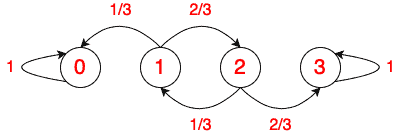
The problem starts at state 1. As has been explained in the lessons of this course, we use the following equation:
\begin{equation}
s_1 = \sum_{i=0}^{3}p_{1,i}s_i
\end{equation} \begin{equation}
s_2 = \sum_{i=0}^{3}p_{2,i}s_i
\end{equation} Furthermore, $s_0=0$ and $s_3=1$. Then we have
\begin{equation}
s_1 = \frac{1}{3}*0 + \frac{2}{3} * s_2
\end{equation} \begin{equation}
s_2 = \frac{1}{3}* s_1 + \frac{2}{3} * 1
\end{equation} Solving these equations gives us $s_1=4/7$ and $s_2=6/7$. So, starting with 1 dollar, player A has a 4/7 chance of winning.
Proof
If we substitute Equation 4 in Equation 3, we have
\begin{equation}
s_1 = \frac{1}{3}*0 + \frac{2}{3} * (\frac{1}{3}* s_1 + \frac{2}{3} * 1)
\end{equation} \begin{equation}
s_1 = \frac{2}{9} * s_1 + \frac{4}{9}
\end{equation} \begin{equation}
\frac{7}{9} * s_1 = \frac{4}{9}
\end{equation} \begin{equation}
s_1 = \frac{4}{9} / \frac{7}{9} = \frac{4}{7}
\end{equation}
All Faces
EasyShow solution
n \Sigma_{k=1}^n \frac{1}{k}
\end{equation} which, for large n is approximately n log n.
The time until the first result appears is 1. After that, the random time until a second (different) result appears is geometrically distributed with parameter of success 5/6, hence with mean 6/5 (recall that the mean of a geometrically distributed random variable is the inverse of its parameter). After that, the random time until a third (different) result appears is geometrically distributed with parameter of success 4/6, hence with mean 6/4. And so on, until the random time of appearance of the last and sixth result, which is geometrically distributed with parameter of success 1/6, hence with mean 6/1. This shows that the mean total time to get all six results is \begin{equation}
6 \Sigma_{k=1}^6 \frac{1}{k} = \frac{147}{10} = 14.7
\end{equation}
Multiply 3 Dice
EasyShow solution
- 1*1*1 = 1 (odd)
- 3*3*3 = 27 (odd)
- 5*5*5 = 125 (odd)
- 1*1*3 = 3 (odd)
- 3*3*5 = 45 (odd)
- etc.
So, in any other scenario than multiplying three odd numbers, the product will be even. Therefore, the probability that the product is even is, given that half of the sides of the dice are odd ({1,3,5} vs {2,4,6}) equal to \begin{equation} P(even \; product) = 1 - P(only \; odd \; product) \end{equation} \begin{equation} P(even \; product) = 1 - (\frac{1}{2})^3 = \frac{7}{8} \end{equation}
Fox vs. Duck
MediumCan the duck always reach the shore without being caught by the fox?
Show solution

Once the duck is at an angle of $\pi$ from the fox, it starts swimming towards the shore.
- The duck has to cover a distance of $\frac{3r}{4}$
- The fox has to cover a distance of $\frac{2\pi \cdot r}{2}$

Since the fox moves four times faster, the distance of the fox has to be larger than four times the distance of the duck.
As we can see, \begin{equation}\frac{3r}{4} * 4 < r* \pi \end{equation} \begin{equation} 3r < 3.14r \end{equation} \begin{equation} 3 < 3.14 \end{equation} Therefore, the duck will survive!
The King's Party
MediumHow can he figure out which bottle was poisoned in time for the party?
Show solution
- The king assigns each servant a number from 1 to 10.
- The king assigns each bottle a number from 0 to 999.
- 0: 000000000
- 1: 000000001
- 2: 000000010
- 3: 000000011
- 4: 000000100
- ...
- 999: 1111100111.
Convert this binary number to a decimal and that gives you the number of the poisoned wine.
Ready for the full question bank?
You just worked through 5 of our free sample questions. Full access unlocks 500+ interview questions, timed mock OAs, progress tracking, and detailed analytics across every trading firm listed above.