
Coin, dice, and card probability questions involving expected value, Bayes, Markov chains, and more — all at quant-trading-firm difficulty.
- Free preview
- Full worked solutions
- Easy
Probability and statistics are central to most quant-trading screens, and the same themes come up across firms: Bayes' theorem, expected value, variance of sums, coupon collectors, random walks, card and dice problems, and more.
The questions below are real examples from our full bank, each with a complete solution. Give a problem a proper attempt before you expand it — and if you catch yourself peeking early, add it to your study plan and come back to it cold.
Sample Questions & Solutions
Each question is a real interview problem. Try it yourself first, the full solution is revealed below.
Bankrupt
EasyWhat is the probability that player A wins?
Show solution
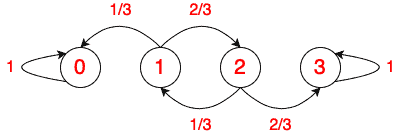
The problem starts at state 1. As has been explained in the lessons of this course, we use the following equation:
\begin{equation}
s_1 = \sum_{i=0}^{3}p_{1,i}s_i
\end{equation} \begin{equation}
s_2 = \sum_{i=0}^{3}p_{2,i}s_i
\end{equation} Furthermore, $s_0=0$ and $s_3=1$. Then we have
\begin{equation}
s_1 = \frac{1}{3}*0 + \frac{2}{3} * s_2
\end{equation} \begin{equation}
s_2 = \frac{1}{3}* s_1 + \frac{2}{3} * 1
\end{equation} Solving these equations gives us $s_1=4/7$ and $s_2=6/7$. So, starting with 1 dollar, player A has a 4/7 chance of winning.
Proof
If we substitute Equation 4 in Equation 3, we have
\begin{equation}
s_1 = \frac{1}{3}*0 + \frac{2}{3} * (\frac{1}{3}* s_1 + \frac{2}{3} * 1)
\end{equation} \begin{equation}
s_1 = \frac{2}{9} * s_1 + \frac{4}{9}
\end{equation} \begin{equation}
\frac{7}{9} * s_1 = \frac{4}{9}
\end{equation} \begin{equation}
s_1 = \frac{4}{9} / \frac{7}{9} = \frac{4}{7}
\end{equation}
All Faces
EasyShow solution
n \Sigma_{k=1}^n \frac{1}{k}
\end{equation} which, for large n is approximately n log n.
The time until the first result appears is 1. After that, the random time until a second (different) result appears is geometrically distributed with parameter of success 5/6, hence with mean 6/5 (recall that the mean of a geometrically distributed random variable is the inverse of its parameter). After that, the random time until a third (different) result appears is geometrically distributed with parameter of success 4/6, hence with mean 6/4. And so on, until the random time of appearance of the last and sixth result, which is geometrically distributed with parameter of success 1/6, hence with mean 6/1. This shows that the mean total time to get all six results is \begin{equation}
6 \Sigma_{k=1}^6 \frac{1}{k} = \frac{147}{10} = 14.7
\end{equation}
Multiply 3 Dice
EasyShow solution
- 1*1*1 = 1 (odd)
- 3*3*3 = 27 (odd)
- 5*5*5 = 125 (odd)
- 1*1*3 = 3 (odd)
- 3*3*5 = 45 (odd)
- etc.
So, in any other scenario than multiplying three odd numbers, the product will be even. Therefore, the probability that the product is even is, given that half of the sides of the dice are odd ({1,3,5} vs {2,4,6}) equal to \begin{equation} P(even \; product) = 1 - P(only \; odd \; product) \end{equation} \begin{equation} P(even \; product) = 1 - (\frac{1}{2})^3 = \frac{7}{8} \end{equation}
Cash or Reroll
EasyPlaying to maximise your expected payout, what is the fair value of this game?
Show solution
What is a fresh roll worth?
If you discard the first roll, you are paid whatever the second roll shows, with no further choices. The second roll is a fair eight-sided die, so its expected value is the average of the faces: \begin{equation} E[\text{reroll}] = \frac{1 + 2 + 3 + 4 + 5 + 6 + 7 + 8}{8} = \frac{36}{8} = 4.5 \end{equation} So choosing to re-roll is worth $4.5$ on average, no matter what the first roll was.
The decision rule
After seeing the first roll $v$, you choose the better of two options: keep $v$, worth $v$, or re-roll, worth $4.5$. You therefore keep the first roll exactly when \begin{equation} v \geq 4.5 \end{equation} that is, when $v \in \{5, 6, 7, 8\}$, and you re-roll when $v \in \{1, 2, 3, 4\}$.
Computing the game's value
Each first-roll value $v$ occurs with probability $\frac{1}{8}$. For the four low values you re-roll and collect $4.5$; for the four high values you keep $v$. So the fair value is \begin{equation} E[\text{game}] = \frac{1}{8}\Big(\underbrace{4.5 + 4.5 + 4.5 + 4.5}_{v = 1,2,3,4 \text{, re-roll}} + \underbrace{5 + 6 + 7 + 8}_{v = 5,6,7,8 \text{, keep}}\Big) \end{equation} \begin{equation} E[\text{game}] = \frac{1}{8}\big(18 + 26\big) = \frac{44}{8} = 5.5 \end{equation} Notice the value 5.5 sits comfortably above the 4.5 you would get from a single roll with no choice: the option to re-roll the bad half of the die is worth exactly one extra point.
So, the fair value of this game is 5.5
Why practise these
Trading rewards a particular way of thinking — weighing probabilities, reasoning about expected value, updating as new information comes in. These puzzles aren't the job itself, but they run on that same logic, and practising it makes the reasoning feel natural rather than something you're working out for the first time in the interview.
Ready for the full question bank?
You just worked through 4 of our free sample questions. Full access unlocks 500+ interview questions, timed mock OAs, progress tracking, and detailed analytics across every trading firm listed above.