
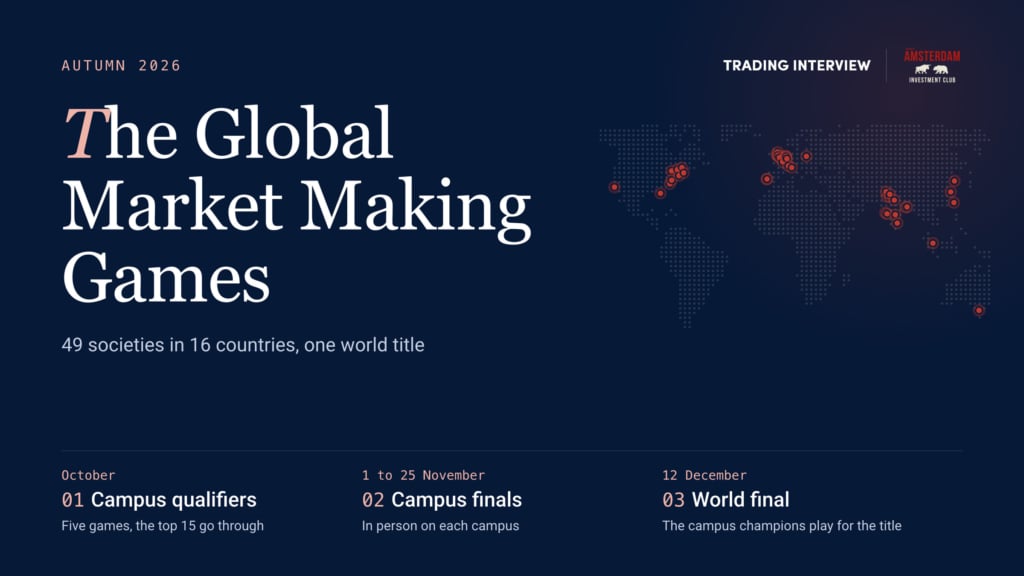
The Global Market Making Games are a competition between university trading and quant societies. Every society plays the same games, the best players go through to a campus final and then a world final, and one player finishes the edition as world champion. The first edition, Autumn 2026, played its qualifiers in October, and the campus finals follow from 1 to 25 November.
The qualifiers are over: 49 societies in 16 countries took part, and 1,461 students finished a qualifier. Below we explain how the competition works, walk through the games of the qualifiers and the campus finals, share the final numbers from the qualifiers and list every society taking part.
Table of Contents
What Are the Global Market Making Games?
The Games are co-hosted by Market Making Games, our multiplayer platform, and the Amsterdam Investment Club. Every round is played on marketmakinggames.com, so a student in Pune and a student in Boston play exactly the same games under the same rules.
There is an edition every spring and every autumn, and each one runs for about three months. Taking part is free for the societies and for their members. Any quant, trading, finance or econometrics society at a university can enter.
How the Competition Works
Each edition has three stages. Every round is a separate tournament, so nobody carries points from one round into the next.
- Campus qualifiers (October)
Each society books a sitting of about 90 minutes, and its members all play at the same time, together in a room or from home. A qualifier is a tournament of five games. The top 15 of every qualifier with more than zero points go through to their society’s campus final. - Campus finals (November)
Each society holds its final in person on its own campus, with the players who came through its qualifier at one table. The session lasts around three hours and produces one society champion. - World final (from 12 December)
Only the society champions play. An online round at 15:00 Amsterdam time cuts the field to ten, and those ten will be invited to Flow Traders’ Super Day, which is the final round of their interview process. The top ten will later play a final together to decide who’s this edition’s world champion!
In the qualifiers and the campus finals, players on equal points are separated by their average finishing position across the games, and after that by countback. If several players still tie for 15th place in a qualifier, all of them go through.
As mentioned above, there is more at stake than the title. Flow Traders invites the ten players at the world final table to a Super Day at its office, the final interview round before an offer.
The Five Qualifier Games
Every campus qualifier plays the same five games, in this order. Each one is also on Trading Interview as a single player game, so you can practise exactly what you will face.
- Fruit Market Game
You price a basket of fruit while its contents keep changing, and trade against the market whenever its bid or ask is wrong. Market events can double or remove a fruit, so the fair value can jump at any moment. - Fermi Questions
One estimation question per round, from hard facts to pure guesstimates. You answer with a single number before the timer runs out, and you score on how close you get in order of magnitude. - Probability Betting Game
Each round offers bets on dice, cards and coins at fixed odds. Some are priced in your favour and some are not, so you pick out the good bets and decide how much to stake on each. - The Marble Olympics
A simulated marble football match runs in real time while you trade a market on the goals and a set of side bets. Prices move with every goal, so speed matters as much as the maths. - Next Card Betting
Cards are dealt face up one at a time, and each round asks a question about the next card. You can see every card that is gone, so the edge is countable and the real skill is sizing your bet.
The Five Campus Final Games
Each campus final plays five games, in this order. Three of them come back from the qualifier, and two are new: Make Me a Market and Market of Cards. In both, the players take turns making a market for the rest of the table, so you quote your own prices and also trade on the other players’ quotes. Each game name links to its page on marketmakinggames.com, which explains the rules with examples and strategies.
- Fruit Market Game
The final opens with the same game as the qualifier. You value the fruit as it keeps changing and trade whenever the market’s bid or ask is wrong. - Make Me a Market
The game is played as a pit around an estimation question, such as a height or a distance. Before the trading starts, you lock in your own estimate, which nobody else sees. Each round one player is in the hot seat and quotes a bid and an ask, and everyone else has a few seconds to buy, sell or pass. After each round you see how many players bought, sold or passed, and that order flow is the only clue to what the others think. At the end you answer questions about your own trades: your position, your worst-case loss, your break-even price and your P&L. - Next Card Betting
Back from the qualifier. You bet on whether the next card is higher or lower, and the cards already dealt tell you how much edge each bet has, so the score rewards taking the good bets and sizing them to that edge. - The Marble Olympics
Also back from the qualifier. You trade the main market on a simulated marble football final, plus the side bets that open during the match, and the teams’ results in the earlier rounds are all you have to judge how good each team is. - Market of Cards
The final closes with the most interactive game. Every player holds two private cards, and the centre cards are turned over one at a time. Players take turns making a market on the total value of all the cards, and everyone else can buy, sell or pass. Each side of a market has a limited size, so the fastest traders get filled.
All five are also on Trading Interview as single player games: Fruit Market Game (free to play), Make Me a Market, Next Card Betting, The Marble Olympics and Market of Cards. A Trading Interview membership also includes full access to marketmakinggames.com, so you can set up a private room and play them in real-time multiplayer before your final.
Autumn 2026 in Numbers
All 49 qualifiers have been played, the last one on 27 October, so the qualifier numbers below are final.
| Autumn 2026 | As of 28 October 2026 |
|---|---|
| Societies | 49 |
| Countries | 16 |
| Students who finished a qualifier | 1,461 |
| Largest qualifier | 152 students (IIT Delhi) |
| World final qualifier | Saturday 12 December 2026 |
India has the most societies, 12, and the most players: 447 students finished a qualifier there. The United Kingdom follows with 362 students from 7 societies, and London alone accounts for 212 of them: UCL Trading Society (72), AlgoSoc at Imperial (70) and the LSESU Data Science and Quant Society (70).
The biggest single sitting was at IIT Delhi, where 152 students played the qualifier of the Quantitative and Algorithmic Trading Club.
| Country | Societies | Students who finished a qualifier |
|---|---|---|
| India | 12 | 447 |
| United Kingdom | 7 | 362 |
| Netherlands | 5 | 128 |
| United States | 6 | 101 |
| France | 3 | 96 |
| Canada | 3 | 56 |
| Australia | 1 | 42 |
| Italy | 2 | 37 |
| Singapore | 1 | 37 |
| Poland | 1 | 33 |
| Portugal | 2 | 31 |
| South Korea | 2 | 27 |
| China | 1 | 23 |
| Switzerland | 1 | 18 |
| Taiwan | 1 | 12 |
| Belgium | 1 | 11 |
The Societies Taking Part
Every society in the Autumn 2026 edition.
| Country | University | Society |
|---|---|---|
| Australia | University of Melbourne | UniMelb Quantitative Trading Society |
| Belgium | KU Leuven | Beta Sigma Club Leuven |
| Canada | Concordia University | QUARCC |
| Canada | Queen’s University | QUANTT |
| Canada | University of Waterloo | Velocity Labs |
| China | NYU Shanghai | NYU Shanghai Economics Society |
| France | ECE Paris | ECE Finance Club |
| France | Université Paris Dauphine-PSL | Stratefi 203 |
| France | École Polytechnique | X Quantitative Society |
| India | BITS Pilani | Quant Club BITS Pilani |
| India | COEP Technological University | COEP Quantitative Finance Club |
| India | IIT Delhi | Quantitative and Algorithmic Trading Club, IIT Delhi |
| India | IIT Kanpur | Finance and Analytics Club IIT Kanpur |
| India | IIT Kanpur | Science & Maths Society at IIT Kanpur |
| India | IIT Kharagpur | Quant Club IIT Kharagpur |
| India | IIT Madras | Quant Guild IIT Madras |
| India | IIT Roorkee | Finance Club IIT Roorkee |
| India | Jadavpur University | FinClub JU |
| India | Jalandhar | Devazy Quant Club |
| India | Mukesh Patel School of Technology Management & Engineering | FinDrome |
| India | National Institute of Technology Warangal | FinWiz |
| Italy | Bocconi University | Bocconi Students Financial Markets |
| Italy | Bocconi University | Milano Students Investment Club |
| Netherlands | Amsterdam (co-host) | Amsterdam Investment Club |
| Netherlands | Erasmus University Rotterdam | Asset Management Student Association |
| Netherlands | Maastricht University | Maastricht Quantitative Research Association |
| Netherlands | University of Amsterdam | Amsterdam Quant Society |
| Netherlands | Utrecht University | A-Eskwadraat |
| Poland | University of Warsaw | Quantitative Finance Student Research Group |
| Portugal | Instituto Superior Técnico, University of Lisbon | Técnico Investment Club Lisbon |
| Portugal | Nova School of Business and Economics | Nova Investment Club |
| Singapore | Nanyang Technological University | NTU Quantitative Research Society |
| South Korea | Korea University | OTM FICC & Quant Club |
| South Korea | Yonsei University | Y-FoRM |
| Switzerland | EPFL | The Finance Association EPFL |
| Taiwan | National Taiwan University | National Taiwan University Team |
| United Kingdom | Durham University | Durham University Finance Society |
| United Kingdom | Imperial College London | AlgoSoc |
| United Kingdom | London School of Economics and Political Science | LSESU Data Science and Quant Society |
| United Kingdom | University College London | UCL Trading Society |
| United Kingdom | University of Manchester | UoM Algorithmic Trading Society |
| United Kingdom | University of Nottingham | NEFS Quant |
| United Kingdom | University of Warwick | Warwick Quant Society |
| United States | Columbia Business School | Quantitative Markets and Trading Club |
| United States | Florida State University | Quant Finance Club at FSU |
| United States | Northeastern University | E[X] Northeastern Prediction Markets Club |
| United States | University of North Carolina at Chapel Hill | UNC Quant Finance Association |
| United States | University of Southern California | QuantSC |
| United States | University of Virginia | Quantitative Traders at Virginia |
How to Take Part
As a Player
You play through a society. Your society books its sitting and shares an invite code with its members, which you enter on marketmakinggames.com to join the qualifier. Each player can play one qualifier, and if you finish in the top 15 you are expected to attend your society’s campus final in person.
If your university has no society in the Games, you can contact your local society to get in touch with the Amsterdam Investment Club to arrange their participation.
As a Society
Societies sign up through our co-host, the Amsterdam Investment Club. The steps are:
- Apply with your society’s details, one contact person, the number of players you expect and your logo.
- Join a 30-minute briefing call.
- Book your qualifier sittings, at least three days ahead.
- Host the qualifier, then host your campus final.
- Send your champion to the world final.
The Autumn 2026 qualifiers are over, so a society that signs up now plays from the spring 2027 edition. Applications go through the Global Market Making Games page of the Amsterdam Investment Club.
Follow the Games
The Global Market Making Games page on marketmakinggames.com shows the edition as it happens: the results of every qualifier, the campus final dates, the champions as they are decided, and the world final qualifier on 12 December. Each society also has its own page with its full results.