
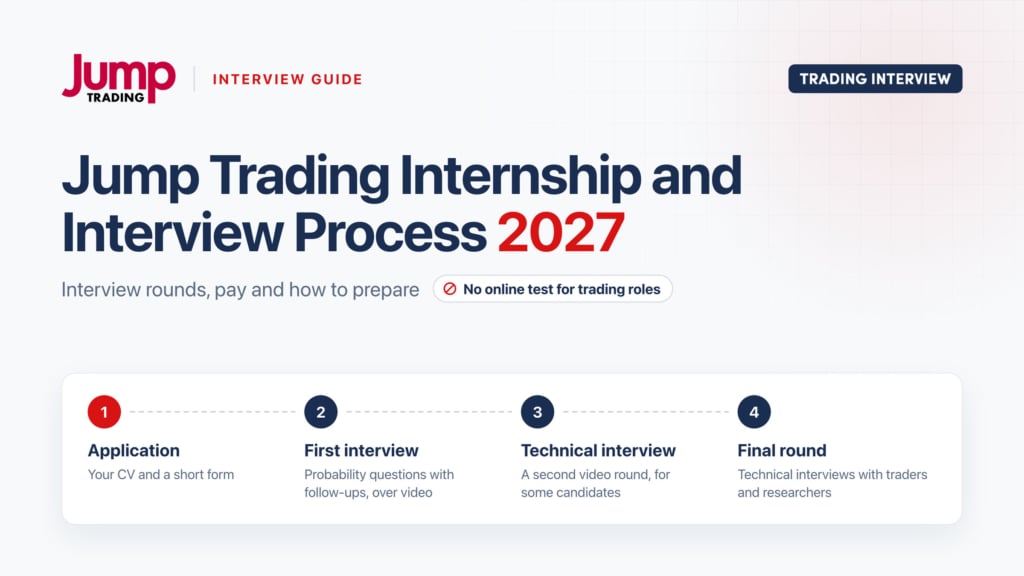
Jump Trading hires quantitative traders without an online test: after your application, every step is a live interview with traders or researchers, built on probability questions that keep growing through follow-ups. This guide covers each round of the interview process and how to prepare.
- Online assessment
There is none for the trading roles. The postings and their application form include no test, and candidates go from their CV straight to a first interview. - First interview
It is a video interview with a trader or researcher, on probability questions with follow-ups, then a conversation about your experience. Some candidates first have a short call with a recruiter. - Technical interview
Some candidates have a second video interview before the final round, with maths and brainteaser questions, and coding can come up as well. - Final round
It consists of technical interviews with traders and researchers. A QT intern candidate reported in October 2026 a final of three technical interviews in person.
In our course
Our Jump Trading lesson in the Company Preparation Course covers the online application, the first interview, the technical interview and the final round, and works through reported probability questions with their follow-ups the way you would answer them out loud. For questions on bets and how much to stake it has our Probability Betting Game and Next Card Betting. Below are the Jump Trading questions in our question bank:
Table of Contents
Jump Trading 2027 internships and graduate roles
Every Quantitative Trader internship posting describes the same intensive 10-week programme. The training covers the three jobs on a Jump trading team, trader, researcher and developer, but centres on trading: strategy and intuition, how markets work, statistics and signal research. Interns have a mentor every day, and the programme includes mock trading sessions and poker training. Graduate traders get the same mix of training, with mock trading and poker, and then work with the trading teams on strategies across global markets.
- Chicago and New York
The internship was posted on 8 July 2026, together with a graduate role that came off Jump’s job board at the start of September. - London and Amsterdam
Jump posted an internship and a graduate role on 13 July 2026. The application form asks which of the two offices you prefer. - Singapore
Jump posted an internship on 3 August 2026, for students who want to work in Singapore full-time after graduating. The timing of applications and interviews there follows university calendars. - Hong Kong and Shanghai
Jump posted an internship on 24 August 2026, for students who want to work in Hong Kong or Shanghai full-time after graduating.
Jump opens its campus roles one region at a time, starting with the US. If you plan to apply to a role in another region, hold off on the US roles.
- Candidate profile
The postings ask for outstanding probabilistic thinking and mathematical reasoning, a competitive spirit, programming experience, an appetite for risk and a real interest in financial markets. - International students
The US and the London and Amsterdam postings encourage international students to apply, and the US graduate posting adds that Jump accepts students eligible for CPT/OPT and sponsors work visas for full-time positions. The Singapore and the Hong Kong and Shanghai postings have no such line.
What changed this cycle
- Earlier postings
The 2027 internships in the US, London, Amsterdam and Hong Kong all went up earlier than the 2026 ones. - The same programme everywhere
In the 2026 cycle, the London and Amsterdam postings described a quant research and trading internship focused on quantitative and programming skills, with machine learning and C++ among the topics and no mock trading or poker, while the US internship already had the trading-focused programme. For 2027, the postings in all four locations describe the trading-focused programme with mock trading and poker training.
Other Jump programmes for students
- Jump Early Access
Jump ran a one-day programme at its Chicago headquarters on 17 April 2026 for first-year undergraduates at US universities studying maths, computer science, physics, statistics, engineering, economics or a related subject. It paid travel, meals and accommodation, no finance knowledge was needed, and you applied with your CV by 5 April. - Jump Trading Probability Cup
Jump ran a public football (soccer) forecasting competition from 11 June to 19 July 2026, open to anyone aged 16 or over. The prize for the best eligible participant aged 18 or over was a paid prediction markets fellowship at Jump’s Chicago headquarters.
Jump’s current openings are listed on our Jump Trading company page.
What Jump pays interns
The Chicago and New York internship posting states: “The estimated base salary for this role is $300,000 per year.” The US graduate posting gave the same figure. The figure is given per year, while the internship lasts 10 weeks, and Jump’s US postings for AI research engineering internships give the same $300,000 marked “annualized”. No posting says what an intern is paid in total.
- Other US internships
The Quantitative Researcher and AI research engineering internships also state $300,000, and the software engineering internship states $250,000. - Outside the US
None of Jump’s campus postings for London, Amsterdam, Singapore, Hong Kong or Shanghai gives a figure.
Overview of the Jump Trading interview process
After the application, every round is an interview with traders or researchers, and the first interviews centre on probability questions that keep growing through follow-ups. The number of rounds varies from candidate to candidate. The usual pattern is:
- Application
You send your CV and fill in a short form. There is no test. - First interview
This is a video interview with probability questions and follow-ups, then a conversation about your experience. Some candidates first have a short call with a recruiter. Note: Jump is organised differently from most trading firms. Instead of one team split into desks, it has many separate teams that each run their own strategy, with their own traders, researchers and developers. The First Interview lesson of our Jump Trading course explains this structure, which helps when you are asked why you want to join Jump. - Technical interview
Some candidates have a second video interview before the final round. - Final round
It consists of technical interviews with traders and researchers. A QT intern candidate had it in person in October 2026.
How long it takes
For the 2027 roles, posted from July 2026, London candidates were being interviewed by mid-August, and a US intern candidate had a first round in early September. A candidate outside the US reported in September that interviews were only starting to roll out. In Singapore, the timing follows university calendars.
Replies can take a long time, and a rejection does not always come. A US intern candidate who applied in July 2026, when the postings came out, still had no reply two months later. Another candidate wrote in September of being ghosted, and a US graduate candidate only received a rejection after emailing Jump to ask. So silence can mean you are out, or that your application has not been reached yet. Once the interviews start, things move quickly according to candidates.
Does Jump Trading have an online assessment?
Not for its trading roles. None of the Quantitative Trader postings or their application forms includes a test, and candidates who describe the trading process go from their CV to a first interview.
The “Jump OA” you may read about belongs to software engineering. Software candidates reported Codility and HackerRank tests in 2021 and 2022, and an experienced Core Development software candidate reported in July 2025 an online assessment and a phone screen before a day of coding interviews. Jump’s software engineering internship posting itself mentions no test.
Stage 1: Jump Trading online application
You apply on Jump’s careers site with your CV; a cover letter is optional. The form also asks for your university, degree and graduation date, whether you need visa sponsorship, any notice period, whether you hold offers or deadlines from other firms, and which other Jump offices you would move to.
- Other offers
If another firm has given you an offer with a deadline, say so: the form asks exactly that.
In our course
The Online Application lesson of our Jump Trading course elaborates on what to take into account while applying.
Stage 2: Jump Trading first interview
The first interview is a video call with a trader or researcher. It centres on probability: candidates in 2025 and 2026 describe questions that the interviewer keeps extending with follow-ups.
- How to answer
A Chicago graduate candidate who interviewed in September 2025 found that the interviewer wanted the explanation and the assumptions before any numbers. After the probability question came their experience and time for their own questions. - Pace
An intern candidate who reported in September 2025 found the probability questions difficult and quick-fire. - Motivation
The same candidate was asked to talk about themselves and what attracts them to Jump. - Example question
A candidate for a trading role in Mumbai reported in June 2026 a card question on the chance of drawing a red queen once some black cards are taken out, with the difficulty going up at every step. - Recruiter call
Some candidates first have an introductory call with HR on motivation and the usual behavioural questions, as a quant intern candidate reported in June 2026.
In our course
The Round 1 lesson of our Jump Trading course works through a red queen question and six follow-ups the way you would answer them out loud, and covers the recruiter call and the motivational questions.
Stage 3: Jump Trading technical interview
Some candidates have a second video interview before the final. A QT intern candidate reported in October 2026 two Zoom interviews before the in-person final, with traders and researchers who ask many follow-up questions. Expect maths and brainteaser questions, and coding can come up as well. Others go straight from their first interview to the final round: the quant intern candidate of June 2026 had one technical round after the recruiter call, with a coding section next to the maths and the brainteasers.
That candidate was asked for the expected number of rolls of a die until two sixes in a row.
In our course
The Round 2 lesson of our Jump Trading course solves the two-sixes question and a follow-up with a different answer, and covers the maths, brainteaser and coding questions.
Stage 4: the Jump Trading final round
The final round is technical. A QT intern candidate reported in October 2026 a final of three technical interviews in person, and a quant intern candidate described in June 2026 a superday of several rounds on coding, brainteasers and statistics.
Expect brainteasers, statistics and coding, and interviewers who ask many follow-ups.
In our course
The Final Round lesson of our Jump Trading course covers the typical type of question that you can expect on the day, works through a probability question with its follow-ups, and lists what to revise for the statistics and coding, together with our Probability Betting Game and Next Card Betting for questions on bets and how much to stake.
Quant research and software engineering at Jump
Jump’s other campus tracks have their own interviews, and many reports about Jump come from them. If you read about a step that is not in this guide, check which track it was for.
- Quantitative Researcher
The postings put computer science, machine learning, statistics and mathematics first. QR candidates reported in September and October 2026 a casual call with Jump, linear algebra questions such as a variant of ridge regression, a coding problem, and an onsite of four interviews with no online test. - Software engineering
The internship is the main way Jump finds young engineers for its core development team, and needs no finance or economics background. The online tests in Jump reports come from these candidates.
How to prepare for Jump Trading
Prepare for live probability questions that grow with every answer, not for a timed test.
- Probability and expected value
The reported questions use cards and dice. Practise out loud: explain your approach and state your assumptions before you calculate. Our question bank has probability and statistics questions and the questions tagged Jump Trading. - Speed
The questions come quickly, so make standard probability calculations routine. Our Interview Questions Trainer puts our bank questions against a timer. - Brainteasers, statistics and coding
All three come up, most of all at the final round. Practise with our brain teasers and programming questions, and refresh the theory in our Probability and Statistics Theory course. - Risk-taking
The postings ask for an appetite for risk, so be ready to reason about whether a bet is worth taking and how much to put on it. Our Probability Betting Game and Next Card Betting train you to spot when you have an edge and size your bet with the Kelly criterion. Both are also on Market Making Games: Probability Betting and Next Card Betting.
For everything in one place:
- Jump Trading practice hub
Our Jump Trading practice hub puts our Jump Trading interview questions and the training we recommend for Jump Trading on one page. - Jump Trading lesson
For every round with worked examples, see the Jump Trading lesson in our Company Preparation Course.
FAQ
What does Jump Trading do?
Jump is a global, privately held trading firm. It trades equities, options, credit, commodities, digital assets and futures, with strategies from high-frequency trading and statistical arbitrage to discretionary macro, and builds its own technology, down to custom hardware.
Is Jump Trading a hedge fund?
No. Jump does not offer investment services to the public: it is a privately held trading firm whose trading teams of traders, quantitative researchers and engineers work together on the global markets.
Is Jump Trading the same as Jump Crypto?
Jump Crypto has its own job board, which lists only crypto researcher roles. The campus Quantitative Trader roles are all Jump Trading roles.
When does Jump Trading open its internships?
A year ahead, region by region. For 2027, the first postings went up in Chicago and New York on 8 July 2026, and the last in Hong Kong and Shanghai on 24 August.
How much do Jump Trading interns make?
Jump’s Chicago and New York internship posting states an estimated base salary of $300,000 per year, for an internship that lasts 10 weeks. No posting gives a total for the internship, and the postings for London, Amsterdam, Singapore, Hong Kong and Shanghai give no figure.
Can international students apply to Jump Trading?
Yes. The US and the London and Amsterdam postings encourage international students to apply, and the US graduate posting adds that Jump sponsors work visas for full-time positions. The Singapore internship and the Hong Kong and Shanghai internship are for students who want to work in that city full-time after graduating.
How hard is it to get a Jump Trading internship?
Hard. A QT intern candidate reported in October 2026 that the process is challenging, that interviewers ask many follow-ups, and that Jump does not hire many interns.
Does Jump Trading have an online assessment?
Not for trading roles: the Quantitative Trader postings and application form include no test, and the first step after your CV is an interview. The online tests you read about come from software engineering candidates.
Does Jump Trading send rejections?
Not always: in September 2026, a US graduate candidate reported getting a rejection only after emailing Jump to ask.